
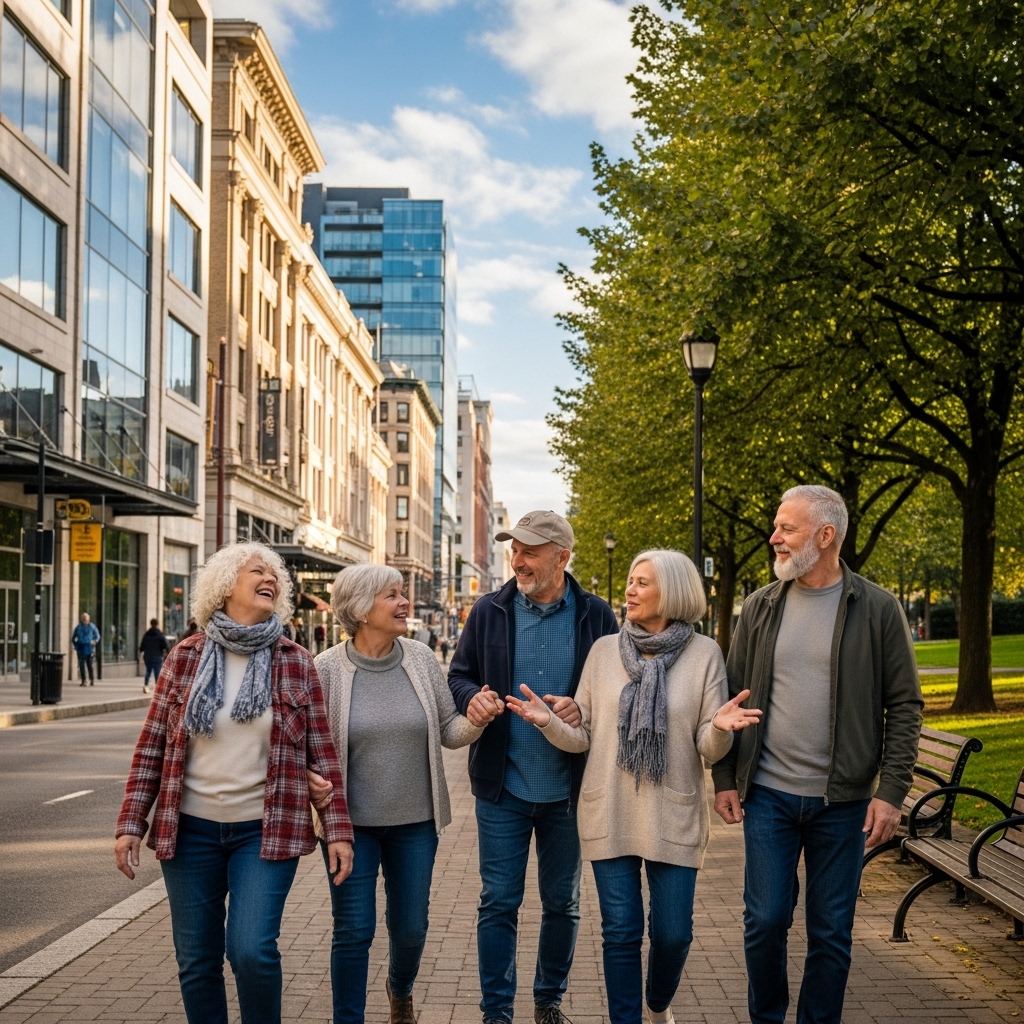
As cities around the world invest hundreds of millions in "15-minute neighborhoods" to foster community connection, we are learning something profound about the nature of loneliness and belonging. The movement to create walkable, connected neighborhoods offers insights that extend far beyond urban planning — particularly for how we think about housing and community across all life stages.
The renaissance of neighborhood design
The 15-minute city concept — ensuring residents can access daily necessities within a short walk or bike ride — is attracting significant investment worldwide. Paris committed hundreds of millions of euros to pedestrianization and cycling infrastructure, and cities from Cleveland to Copenhagen are following with substantial investments of their own. Cities pursuing these designs report gains in community mental health, local business engagement, and property values in walkable neighborhoods.
But here is the deeper insight: physical proximity alone doesn't automatically create community. It requires purposeful, intergenerational interaction.
Loneliness doesn't care where you live
Research reveals a surprising pattern: gathering people together — whether in assisted living facilities, planned communities, or traditional neighborhoods — does not automatically solve isolation. Studies consistently find chronic loneliness and depression to be strikingly common in institutional settings for older adults, at rates well above those of people living independently in their own homes, despite the physical closeness of neighbors and scheduled activities. Connection requires more intentional design than proximity or programming can provide.
The intergenerational advantage
What the 15-minute city movement is rediscovering mirrors humanity's evolutionary blueprint: mixed-age communities where knowledge flows naturally between generations. For most of human history, multigenerational support was the norm.
The research on intergenerational connection shows measurable benefits in both directions. For older adults, multigenerational living is associated with higher life satisfaction, and staying active with younger people supports mobility and purpose. For younger generations, developmental research suggests children thrive with several involved, caring adults in their lives, and close relationships with grandparent figures are associated with better emotional wellbeing.
Purpose matters as much as company. As physical limitations increase with age, knowledge transmission becomes a superpower: passing on skills, history, and judgment that cannot be googled. Occupying that role gives people meaning no medication can provide. Yet where age segregation is absolute, these natural pathways to purpose are severed. The separation of generations isn't natural — it is largely a 20th-century development of zoning and age-segregated housing.
Evidence from homeshare programs
Real-world data shows what happens when intergenerational connection is intentionally designed into housing. In one study of intergenerational homesharing, 93% of older home providers reported benefiting from the arrangement, and nearly as many felt the younger participant benefited too. Toronto's HomeShare program found participants overwhelmingly agreed that homesharing addresses the risk of social isolation (95%), the pressure to move away from one's community (96%), and economic exclusion for young and old alike (97%).
The pattern repeats in Boston's pilot program, where typical homeshare rent was around $700 and some tenants reduced rent further by helping with errands and pet care — but the true value emerged in the relationships. As one Boston host put it: "I'm an empty-nester, and he brings a presence into my home that makes it feel so much more alive and full." Notably, while only about 10% of homeowners initially cited companionship as their motivation, a strong majority later reported that companionship had reduced their loneliness.
This isn't about replacing other housing options — it is about expanding choices, and demonstrating that when housing incorporates genuine intergenerational connection, financial and social benefits multiply together.
Business is noticing
Organizations are recognizing loneliness as both a social challenge and a business one. CVS Health has converted stores into "HealthHUB" locations that function partly as community gathering spaces. Best Buy's Assured Living division teaches digital literacy through workshops where younger staff help older adults navigate technology. Coffee shops and developers increasingly design intentional "third places" — communal tables, mixed-age programming, partnerships with local organizations — because they understand that belonging drives loyalty in ways amenities never will.
The path forward
As we rebuild neighborhoods, belonging needs more than walkability. It needs collision points — community gardens, little free libraries, porch culture — where neighbors meet daily. It needs social infrastructure like skill-share circles matching retired professionals with young adults. It needs economic models where help flows both ways, including arrangements where tenants trade a little everyday help for reduced rent in a homeowner's house. And it needs purposeful integration: teaching kitchens, fix-it cafés, and shared homes where generations actually live alongside each other.
By one widely cited estimate, loneliness costs the U.S. economy hundreds of billions of dollars a year — and the U.S. Surgeon General has called social disconnection an epidemic, linking it to higher risks of heart disease, stroke, and dementia. The communities that thrive in the next decade won't be those with the best amenities; they will be those that understand a fundamental truth: humans need purposeful, intergenerational connection more than they need proximity alone.
Because the ultimate lesson from both urban planning and elder care is this: proximity without purpose is just organized isolation.
Home sharing is one practical way to build that connection into everyday life — one spare bedroom at a time. Learn how ResidAlly makes it safe and simple, from screening to digital leases.